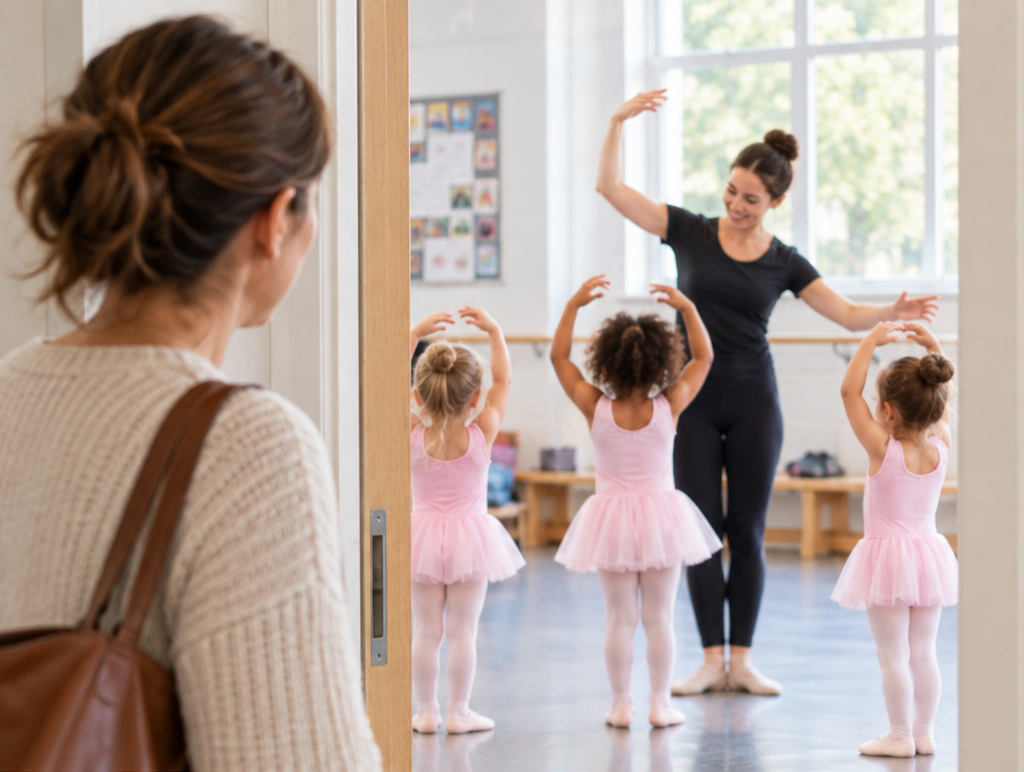
Yes—you can still look in on your child during their Kinderballet class.
For most of our independent classes, we ask parents and carers to wait just outside the teaching space. This gives children the opportunity to focus, connect with their teacher and gradually develop confidence on their own.
However, this is not a rigid rule. If your child is not ready to be without you, you can remain in the room while we help them settle. Some children are comfortable straight away; others need a gradual transition—and even a usually confident child can have a more fragile week.
Our approach is simple: we encourage independence while providing the reassurance each child and parent needs.
In our Cherubs and Mummy & Me programs, a parent or carer remains in the room and participates in the class with their child.
At this age, having a familiar adult nearby helps children feel secure enough to explore movement, music and the class environment. You are not expected to sit and watch from the side—you become part of the experience.
As children move into our more independent programs, we gently begin supporting them to participate without a parent beside them.
Young children have a great deal to take in during a class. They are listening to the teacher, learning the class routine, following stories and music, watching other children and discovering what their bodies can do.
A quieter teaching space makes all of this easier.
Parents may understandably need to talk, answer a phone or attend to another child. Younger siblings may be eating, playing, moving around or crying. None of these things is wrong—it is simply family life—but inside a small class they can quickly draw children’s attention away from their teacher.
A child who sees their parent may also return repeatedly for a cuddle, drink or snack, rather than becoming absorbed in the class.
By asking families to wait outside, we create a calmer space in which the children can:
It also gives each child the lovely experience of having an activity that feels like their own.
Waiting outside the teaching space does not mean being disconnected from your child.
Kinderballet has an open-door approach. Depending on the venue, parents can look in through a viewing area, window or open studio door. You remain nearby and can see how your child is settling and participating.
Different Kinderballet venues have different layouts, so the exact viewing arrangement may vary. Your local teacher will show you where to wait and how you can look in without distracting the class.
That is completely okay.
Starting a new class can feel very different from one child to another. Some children walk in happily on their first day. Some prefer to watch before participating. Others need their parent beside them while they become familiar with the teacher, the room and the class routine.
If your child needs you, you can remain in the room.
We may then work with you on a gradual transition. For example, you might initially participate or sit close to your child, then move towards the edge of the room, then wait near the doorway and eventually move into the designated parent area.
There is no need to force a sudden separation. The aim is confident independence—not independence before your child is ready.
Your child may also need you again occasionally. Tiredness, illness, a disrupted routine or something happening at home can make a normally confident child feel more vulnerable. If they are having a fragile week, we respond to the child in front of us rather than insisting on a rule.
Please speak with the teacher so that you can decide together what will best support your child that day.
Your child’s first class is an opportunity for both of you to become familiar with Kinderballet.
Your teacher will explain where parents usually wait, how you can view the class and what to do if your child is hesitant. If your child needs you in the room initially, that can be accommodated.
A child who watches, stays close to their parent or joins in only briefly is still learning. They are taking in the room, the people, the music and the class routine. Participation often grows as the environment becomes familiar.
This is one reason we encourage families to give children time to settle rather than judging the experience by the first few minutes of one class.
In addition to our parent-participation programs, a parent or carer may remain in the teaching space when:
The needs of the whole class still matter, so we ask adults in the room to follow the teacher’s guidance and minimise conversation, movement and other distractions.
Parents know their children best. Our teachers understand the rhythms of the class and can often recognise the difference between a child who needs their parent and a child who is ready to become involved once their parent steps just outside.
By working together, we can provide both reassurance and room to grow.
Our goal is never to make a child feel abandoned or to make a parent feel unwelcome. It is to create a calm, focused class in which children feel safe enough to participate, connect and gradually become more independent—with their parent never far away.
Every child is different. If you are unsure whether your child will be comfortable without you in the room, speak with us before their first class.
We can explain how the viewing arrangement works at your chosen venue and discuss a settling-in approach that suits your child.
[Find a Kinderballet class near you]
